Radicle: A Peer-to-Peer, Decentralized Alternative to GitHub
Table of Contents
- Introduction
- Key Features at a Glance
- The Radicle Philosophy: Who Is It For?
- GitHub vs. Radicle: A Quick Comparison
- How the Peer-to-Peer Model Works
- Getting Started with Radicle
- Pros and Cons
- Frequently Asked Questions (FAQ)
- Conclusion
- Getting Started & Further Reading
Introduction
Codeberg and SourceHut, both covered elsewhere in this series, address centralization by putting a non-profit or a single trusted operator in charge instead of a corporation. Radicle takes a fundamentally different approach: it removes the central server from the equation entirely. There is no company running Radicle’s infrastructure, because Radicle doesn’t have centralized infrastructure to run.
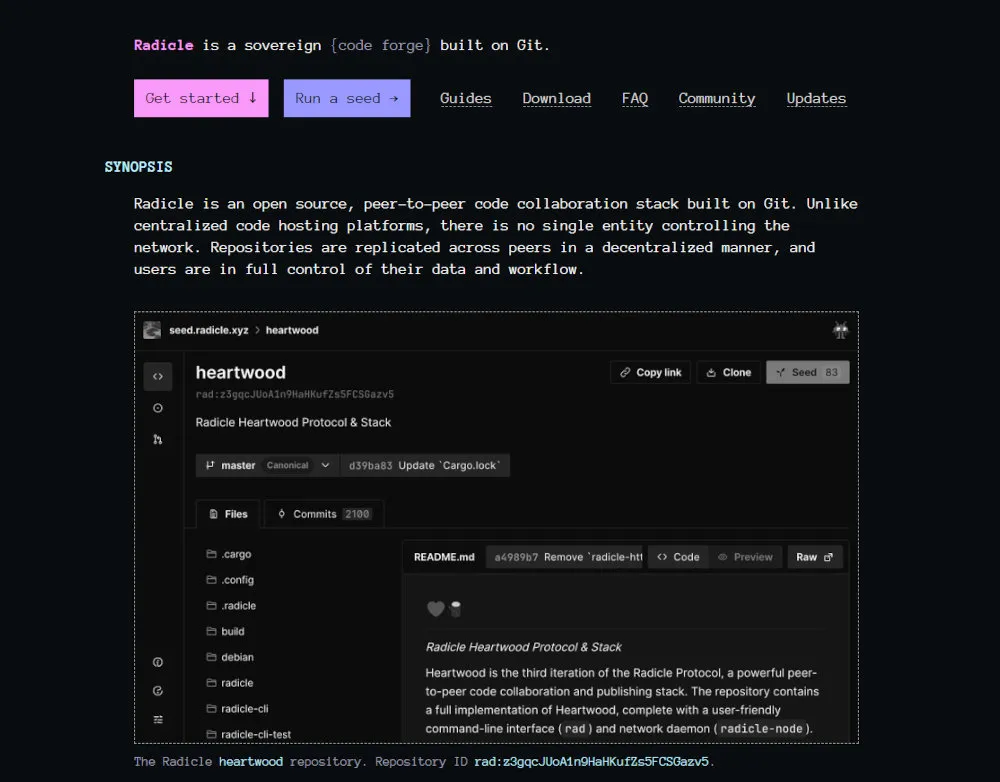
Radicle is a peer-to-peer protocol built directly on top of Git. Instead of your repository living on a server owned by GitHub, GitLab, or anyone else, it’s replicated across a network of independent nodes, potentially including your own laptop, run by anyone who chooses to “seed” it. Your identity isn’t a username tied to a company’s database; it’s a cryptographic keypair you control, the same trust model Git itself already uses for signed commits.
The result is a platform that can’t be bought, can’t unilaterally suspend an account, and can’t take a project offline just by deciding to. What it asks in return is a genuine shift in how you think about hosting, discovery, and availability.
Key Features at a Glance
| Feature | Description | Key Benefit |
|---|---|---|
| Peer-to-Peer Replication | Repositories are gossiped between nodes on the network rather than stored on one central server. | No single company or server outage can take a project offline as long as at least one node is seeding it. |
| Self-Sovereign Identity | Your identity is a cryptographic keypair you generate and control, not an account issued by a company. | Nobody can suspend, ban, or delete your identity, because nobody but you controls the key behind it. |
| Native Issues and Patches | Issues and patches (Radicle’s term for pull requests) are stored as Collaborative Objects, or COBs, inside the repository itself. | Collaboration history travels with the code wherever it’s replicated, instead of living in a separate company database. |
The rad CLI | A command-line tool for initializing, cloning, seeding, and collaborating on Radicle projects. | Gives you full control over the network without depending on any particular web interface being online. |
| Run-Your-Own-Node Model | Anyone can run a lightweight Radicle node to seed the projects they care about, with public seed nodes available for extra availability. | Lets communities keep a project reliably available without needing anyone’s permission or a hosting bill. |
The Radicle Philosophy: Who Is It For?
Radicle’s philosophy is no single point of control, by design. It isn’t trying to be a friendlier corporate host or even a better-governed non-profit one. It’s trying to make the question “who could take this project offline?” have no answer at all.
This makes it the right choice for:
Open-Source Maintainers Who Want True Independence: If you want your project’s existence to depend on nobody’s business decisions, terms of service, or continued solvency, Radicle removes that dependency structurally rather than by policy.
Censorship-Resistance Advocates: Projects operating under legal or political pressure in some jurisdictions benefit from a hosting model with no central server to compel or block.
Developers Comfortable with the Command Line: Radicle’s core workflow runs through the rad CLI, so it suits developers who are happy working without a polished web dashboard for every action.
Communities Willing to Run Their Own Infrastructure: Because availability depends on seeding, Radicle rewards teams and communities willing to run a node themselves rather than relying entirely on someone else’s server.
If your read of the last two decades of Git hosting is that centralization itself is the risk, not just which company happens to be in charge of it, Radicle is the most literal answer to that concern in this entire series.
GitHub vs. Radicle: A Quick Comparison
| Aspect | GitHub | Radicle |
|---|---|---|
| Primary Focus | A centralized, general-purpose platform for hosting and collaboration. | A peer-to-peer protocol for hosting and collaborating on Git repositories with no central server. |
| Hosting Model | Centralized SaaS, owned and operated by Microsoft. | Peer-to-peer network of independently run nodes; nobody owns the network itself. |
| Identity | A GitHub account, controlled by GitHub. | A self-generated cryptographic keypair, controlled entirely by you. |
| Availability | Depends on GitHub’s uptime and continued operation. | Depends on at least one node, yours or a public seed node, actively seeding the repository. |
| Issues / PRs | Stored in GitHub’s central database. | Stored as collaborative objects inside the repository, replicated along with the code itself. |
| CI/CD | Fully integrated GitHub Actions. | No first-party equivalent; community projects like Radicle CI provide automation, but it isn’t built into the core protocol. |
| Discovery | Global search, trending pages, a massive existing community. | A growing but still modest network; there’s no equivalent to GitHub’s scale of discoverability yet. |
How the Peer-to-Peer Model Works
Every Radicle repository has a Radicle ID (an RID), derived cryptographically, that uniquely identifies it across the network regardless of which node happens to be hosting a copy at any given moment. When you run a Radicle node and choose to “seed” a repository, your node stores a full copy and makes it available to other peers who ask for it, the same replication logic that makes Git itself distributed, extended into an actual network protocol.
This has a direct consequence worth being honest about: a Radicle repository is only as available as the nodes currently seeding it. If you’re the only person seeding your own project and your laptop is off, nobody else can clone it in that moment. In practice, this is addressed by public seed nodes, run by community members or projects specifically to keep popular repositories available even when their original authors are offline, but it’s a meaningfully different availability model than “GitHub’s servers are basically always up.”
Identity works the same way as everything else here: decentralized. Your Radicle identity is a keypair you generate locally, and your public key is how others verify that a given contribution, issue, or patch actually came from you. There’s no central authority issuing or revoking these identities.
It’s also worth knowing that Radicle wasn’t always this shape. Earlier iterations of the project experimented with an Ethereum-based registry for organization identities, back when the project leaned more heavily on blockchain concepts. The protocol used today doesn’t require a blockchain at all; the peer-to-peer gossip network handles replication and discovery on its own.
Getting Started with Radicle
- Install the
radCLI: Follow the installation instructions for your platform from the official Radicle documentation. - Set Up Your Identity: Run
rad authto generate your cryptographic keypair, which becomes your Radicle identity. - Run a Node: Start your local Radicle node so you can seed and sync repositories.
- Initialize a Project: From inside an existing Git repository, run
rad initto publish it to the Radicle network under a new Radicle ID. - Clone Someone Else’s Project: Use
rad clone <rid>with a project’s Radicle ID to fetch it from whichever nodes are currently seeding it. - Collaborate: Use
rad issueto open issues andrad patchto propose changes, Radicle’s equivalent of a pull request.
# Publishing an existing local Git repository to Radicle
rad auth
rad init

# Cloning someone else's project by its Radicle ID (RID)
rad clone <rid>
Pros and Cons
Why You Might Choose Radicle
Genuine Censorship Resistance: With no central server or company, there’s no single entity that can suspend an account or take a project offline by policy decision.
Self-Sovereign Identity: Your identity is a key you control, not an account a platform could revoke.
Built Directly on Git: Most of your existing Git knowledge and tooling still applies; Radicle adds a collaboration and replication layer rather than replacing Git itself.
No Hosting Bill, No Vendor: There’s no company to pay, and no vendor whose pricing changes or acquisition could affect your project down the line.
Open Source and Actively Developed: The protocol and tooling are fully open source, with an active community continuing to build out the ecosystem.
Privacy-Conscious by Design: Private repositories are supported at the protocol level, and the project has ongoing work toward routing node traffic over Tor for teams that want an added layer of network privacy on top of the decentralization itself.
Potential Drawbacks
Availability Depends on Seeding: A project with nobody actively seeding it becomes unreachable, a fundamentally different risk profile than a centralized platform’s uptime guarantees.
Small Network Relative to GitHub: Discovery, community size, and third-party integrations are all far behind what two decades of centralized platforms have built up.
Core Collaboration Is CLI-First: A web explorer and a desktop client exist for browsing and lighter interaction, but issues, patches, and identity management are still primarily handled through the rad CLI, and neither web option matches the depth of GitHub’s full dashboard yet.
No Built-In CI/CD: There’s no first-party equivalent to GitHub Actions, though community solutions like Radicle CI are already in production use for some projects. Automation generally has to be wired up separately, and the peer-to-peer model makes some traditional CI/CD patterns less straightforward than on a centralized platform.
Smaller Network, Still Maturing: The current Heartwood-based protocol is past its 1.0 release and continues to ship regular updates, with a real but still modest number of repositories and nodes. It’s a mature piece of software at this point, just one running on a network far smaller than GitHub’s.
Frequently Asked Questions (FAQ)
Q: Is Radicle built on a blockchain? A: Not anymore, in the sense that matters for daily use. Earlier versions of the project experimented with an Ethereum-based registry for organization identities, but the current protocol replicates repositories and handles identity through peer-to-peer networking alone, with no blockchain required to use it.
Q: What happens to my project if nobody is seeding it? A: It becomes temporarily unreachable to new clones until a node seeding it comes back online. This is why projects that care about availability typically rely on a public seed node, or run their own always-on node, rather than depending solely on a contributor’s personal machine.
Q: Can I still use GitHub alongside Radicle? A: Yes. Since Radicle repositories are Git repositories underneath, nothing stops you from mirroring the same project to GitHub for discoverability while treating Radicle as your canonical, censorship-resistant copy.
Q: Is there a web interface, or is Radicle CLI-only?
A: There’s a web-based explorer for browsing public Radicle projects and a desktop client for lighter interaction, but the core collaboration workflow, issues, patches, and identity management, still happens primarily through the rad CLI rather than a full-featured web dashboard.
Q: Do I need to run my own node to use Radicle? A: You need a running node to seed your own work reliably, but you can clone and interact with other people’s projects as long as some node on the network is seeding them, which doesn’t have to be yours.
Q: Is Radicle a cryptocurrency project? A: No, not to use it. Radworks, the organization that funds Radicle’s development, has its own RAD token for its governance and funding model, but the Radicle protocol itself doesn’t require holding any token, paying any fee, or interacting with a blockchain to host or collaborate on a repository.
Conclusion
Radicle isn’t competing with GitHub on features, and it isn’t trying to be a more ethically governed version of the same centralized model, the way some other platforms in this series are. It’s a genuinely different architecture, one where the question of who’s in charge of your project’s availability has a different, much more distributed answer.
That trade-off won’t suit every team. If you need the polish, discoverability, and CI/CD depth of a mature centralized platform, Radicle isn’t there yet. But if the idea of a single company being able to decide your project’s fate, even a well-intentioned one, is the actual problem you’re trying to solve, Radicle addresses it more directly than anything else covered here.
Getting Started & Further Reading
Official Website: https://radicle.dev/
Documentation: https://radicle.dev/guides
Network Explorer: https://radicle.network/, for browsing public projects and seeing live network activity.