Codeberg: A Community-Owned Future for Open Source
Table of Contents
- Part I: The “Why” of Codeberg - A Movement, Not Just a Platform
- Part II: Under the Hood: The Technology Stack
- Part III: Getting Started: Practical “How-To” Guides
- Part IV: Codeberg in Action: Project Showcase and Community
- Part V: The Non-Profit Heart: Governance and Sustainability
- Part VI: How to Get Involved
- Part VII: Conclusion: Why an Independent Forge Matters
- FAQ Section
- References
Last Updated: August 2026. This article was originally published in August 2025 and has been updated to reflect significant changes including Codeberg’s rapid growth milestones, governance restructuring, updated Terms of Use, new storage quotas, Forgejo’s major version releases, high-profile project migrations, and Codeberg’s first public budget disclosure.
Codeberg vs. GitHub at a Glance
| Feature | Codeberg | GitHub |
|---|---|---|
| Ownership | Non-profit (Codeberg e.V.) | Corporate (Microsoft) |
| Core software | Forgejo (open-source) | Proprietary |
| Price | Free (donations welcome) | Free + paid tiers |
| Private repos | Yes (FOSS-aligned content) | Yes (any content) |
| CI/CD | Forgejo Actions + Woodpecker CI | GitHub Actions |
| Pages hosting | Yes (codeberg.page) | Yes (github.io) |
| Package registry | Yes | Yes |
| Federation (Fediverse) | In active development | Not planned |
| Data jurisdiction | EU (Berlin, Germany) | USA |
| AI crawlers | Actively blocked (Anubis) | Limited controls |
| Advertising | None | None |
Part I: The “Why” of Codeberg - A Movement, Not Just a Platform
A. Introduction: What is Codeberg?
Codeberg is a non-profit, community-driven platform for hosting, developing, and collaborating on free and open-source software (FOSS). It is operated by Codeberg e.V., a registered non-profit association based in Berlin, Germany. The platform’s core mission is to provide a reliable and independent home for the creation, archiving, and preservation of code and its development process, intentionally avoiding dependencies on commercial or proprietary services.
B. The Genesis: A Reaction to a Changing Landscape
The idea for Codeberg was born out of a growing concern within the open-source community regarding the commercialization of software development platforms. A significant catalyst was Microsoft’s acquisition of GitHub in 2018, which prompted developers to seek alternatives that were not controlled by large corporations.
Founded in 2019, Codeberg e.V. was established to offer a platform free from the pressures of commercial interests. A key decision was to base the organization and its infrastructure in the European Union. This provides a legal framework that can protect projects from issues like bad-faith DMCA takedown requests common under U.S. law and ensures data is handled under the EU’s strong privacy regulations.
C. The Core Philosophy: Freedom, Privacy, and Community
Codeberg is built on a foundation of principles that set it apart from for-profit competitors. It is a humane, non-commercial, and privacy-respecting alternative, committed to the ideals of the free software movement.
Historically, this was underscored by a strict policy requiring all hosted projects to use an OSI/FSF-approved license. However, in late 2025 the Terms of Use were meaningfully expanded (see Part V for details). The platform now also warmly welcomes creative works such as books, art, conference slides, and public domain content, as long as they are shared under an appropriately open license. This evolution better reflects Codeberg’s mission while resolving previous grey areas for non-software creators.
Part II: Under the Hood: The Technology Stack
A. The Forgejo Foundation
Codeberg is powered by Forgejo, a community-managed, self-hostable software forge that is a hard fork of Gitea. This choice is significant as it means Codeberg’s core infrastructure is itself free and open-source software. Codeberg e.V. serves as the custodian of the Forgejo project, ensuring it remains 100% Free Software. Forgejo is designed to be lightweight, efficient, and easy to maintain, providing a familiar Git-based environment for developers.
Since August 2025, Forgejo has seen remarkable development velocity, with major releases on a quarterly schedule:
- Forgejo v12.0 (July 2025): marked the end of life for the v7.0 LTS series and introduced a range of UI and API improvements.
- Forgejo v13.0 (October 2025): added UI polish such as upload timestamps on release attachments and tags displayed next to commits.
- Forgejo v14.0 (January 2026): a non-LTS release focused on stability and incremental improvements.
- Forgejo v15.0 (April 2026): the 100th release of Forgejo and an LTS version, supported until July 2027. Notable additions include per-repository access token restrictions, improved Forgejo Actions capabilities, a simpler web-based runner registration flow, and responsiveness and accessibility enhancements throughout the UI.
- Forgejo v16.0 (July 2026): a non-LTS release, currently at v16.0.2.
As of August 2026, v15.0.3 remains the recommended LTS release (supported through July 2027) for those prioritizing stability, while v16.0.2 is the latest non-LTS release for those who want the newest features.
B. The Extended Ecosystem: More Than Just a Git Host
Codeberg has expanded its offerings to provide a comprehensive development ecosystem:
Codeberg Pages: A service for hosting static websites directly from a Git repository, much like GitHub Pages. In 2025, Pages received dedicated floating IP addresses separate from Codeberg.org itself, improving reliability and enabling maintenance on one server without taking sites offline. Codeberg is also gradually migrating to a more efficient backend called git-pages.
Forgejo Actions / Woodpecker CI: CI/CD on Codeberg is available both via the integrated Forgejo Actions system (modelled on GitHub Actions) and through the separately hosted Woodpecker CI. Codeberg is investigating solar-powered, off-site runners, including potentially repurposing broken Apple M1/M2 laptops, to expand CI capacity sustainably.
Codeberg Translate (Weblate): A collaborative platform to help projects with software localization and translation.
Package Registry: Support for hosting various software packages and container images, including Docker.
Fediverse / ActivityPub Federation: Forgejo is actively working on ForgeFed federation support. As of 2025, the ability to federate repository “stars” across Forgejo instances has been built. Broader federation (allowing users on one server to interact with projects on another) continues to advance, with Codeberg actively funding review and maintenance of this work.
Anubis Bot Protection: To combat the surge in AI crawler traffic, Codeberg now protects certain high-cost routes on Codeberg.org and most of Codeberg Translate behind Anubis, a lightweight JavaScript proof-of-work challenge. This significantly reduces load from automated scrapers while remaining nearly invisible to legitimate users.
Part III: Getting Started: Practical “How-To” Guides
A. How-To: Migrating Your Project from GitHub to Codeberg
Migrating from GitHub is a straightforward process thanks to Codeberg’s built-in tools.
-
Create a Codeberg Account: Register on Codeberg.org.
-
Generate a GitHub Personal Access Token: In your GitHub developer settings, create a “classic” Personal Access Token with the
reposcope. -
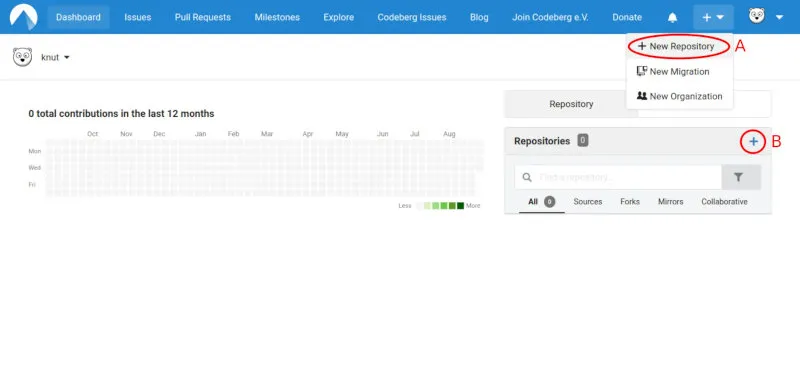
Use the Built-in Migration Tool: On Codeberg, click the ”+” icon in the top right and select “New Migration”.
-
Enter Repository Details: Paste your GitHub repository’s HTTPS URL and authenticate with your GitHub username and the token as the password.
-
Select Items and Begin: Choose which elements to import (issues, pull requests, releases, milestones) and start the migration.
-
Update Your Local Repository: Once migration is complete, point your local clone to its new home:
git remote set-url origin https://codeberg.org/your-username/your-repo.git git push --mirror -
(Optional) Bulk Migration: For those with many repositories, community-developed scripts are available to automate the process. See this bulk migration script and Rahul’s blog post for details.
Storage note (since May 2025): Codeberg now enforces storage quotas. Before migrating a large project, check your usage under User Settings → Storage Overview and request additional headroom via the Codeberg-e.V./requests form if needed. New accounts in particular may need to request an exception before importing large repositories. See the FAQ for current limits.
B. How-To: Publishing a Website with Codeberg Pages
Codeberg Pages makes it simple to host a static website. Here is a minimal index.html to get you started:
<!DOCTYPE html>
<html lang="en">
  <head>
    <meta charset="UTF-8" />
    <title>My Codeberg Site</title>
  </head>
  <body>
    <h1>Hello from Codeberg Pages!</h1>
  </body>
</html>
Simple Method (user/organization site):
- Create a public repository named exactly
pages. - Add your static content (including
index.html) and push to the default branch. - Your site will be live at:
https://{username}.codeberg.page
Advanced Method (project-specific site):
-
Create an orphan branch named
pagesin your repository:git switch --orphan pages -
Push your built site output (e.g.,
public/ordist/) to this branch. -
Your site will be at:
https://{username}.codeberg.page/{repository-name}/
Custom Domain:
-
Create a
.domainsfile in the root of your Pages repository or branch:www.my-project.org my-project.org -
In your DNS provider, add a
CNAMErecord pointing to{username}.codeberg.page. -
If you use A/AAAA records instead of CNAME, use the current dedicated Pages IPs (updated April 2025, check docs.codeberg.org/pages for the latest values):
- IPv4:
217.197.84.141 - IPv6:
2a0a:4580:103f:c0de::2
- IPv4:
C. How-To: Setting Up CI/CD
Codeberg offers two CI/CD options. Forgejo Actions is the easiest starting point: no access request needed.
Option 1: Forgejo Actions (recommended for most users)
Create the file .forgejo/workflows/ci.yml in your repository:
on: [push, pull_request]

jobs:
  test:
    runs-on: docker
    container:
      image: node:20
    steps:
      - uses: actions/checkout@v4
      - name: Install dependencies
        run: npm ci
      - name: Run tests
        run: npm test
      - name: Build
        run: npm run build
Push this file and Forgejo Actions will automatically run your pipeline on every push and pull request. The syntax closely mirrors GitHub Actions, making migration straightforward.
Option 2: Woodpecker CI (for more complex pipelines)
Woodpecker CI is a separate shared service that requires an access request first.
-
Request access via the Woodpecker CI request form to be granted runner access.
-
Create
.woodpecker.ymlin the root of your repository:pipeline: build: image: node:20 commands: - npm ci - npm test - npm run build deploy: image: alpine commands: - echo "Add your deploy step here" secrets: [deploy_key] -
Add secrets for sensitive values (API tokens, deploy keys) via the Woodpecker web UI. Never hardcode them in the YAML file.
-
Push to trigger: Woodpecker detects the file automatically and runs on the next push.
Part IV: Codeberg in Action: Project Showcase and Community
A. Real-World Examples
Codeberg is home to a growing number of diverse open-source projects. Notable examples include:
Forgejo: The very software powering Codeberg is developed on Codeberg itself, a testament to the platform’s maturity.
FFmpeg: The renowned multimedia framework moved its development to a self-hosted Forgejo instance, demonstrating the platform’s robustness for large-scale, high-traffic projects.
GNU Guix: In May 2025, the GNU Guix project, a functional package manager and full GNU operating system with over 33,000 packages and more than 2,000 commits per month, migrated from GNU Savannah to Codeberg. This is one of the most significant migrations to Codeberg to date.
BookStack: The popular open-source documentation and wiki platform completed a full migration of all its repositories from GitHub to Codeberg in April 2026, with GitHub now serving only as a mirror. All issues, pull requests, and contributions are now managed exclusively on Codeberg.
Fedora: The Fedora operating system chose Forgejo as its new development platform, entering into close collaboration with the Forgejo and Codeberg communities. That said, it self-hosts its own Forgejo instance.
CoMaps: A community-driven fork of a popular privacy-friendly offline map and routing application, CoMaps chose Codeberg as its development home, with its first binary available directly from Codeberg.
Countless Individual Projects: Many developers have moved personal blogs, tools, and libraries to Codeberg, drawn by its ethos and feature set.
The Software Freedom Conservancy has also endorsed Codeberg as a recommended alternative in its “Give Up GitHub” campaign, further boosting its visibility and adoption.
B. A Community of Contributors
One of Codeberg’s greatest strengths is its active and supportive community. Users can get help and collaborate through project issue trackers and the central Codeberg Community repository.
Codeberg has established weekly open community meetings every Tuesday at 18:00 Berlin time (17:00 UTC), held via video call and open to all. Topics typically cover technical matters, community building, documentation, and public relations. If you want to discuss something directly with Codeberg contributors or e.V. members, this is a great place to do it.
Part V: The Non-Profit Heart: Governance and Sustainability
A. A Democratic and Transparent Model
Codeberg is operated by Codeberg e.V., a German non-profit association. This structure ensures the platform is governed by its community. Members have voting rights and can influence the platform’s direction and budget at an annual assembly.
Key governance updates since late 2025:
- New Presidium elected for the 2025-2027 term, now comprising members from three European countries (previously exclusively German).
- New Executive Board appointed for 2025–2026, with three members for the first time (the maximum allowed), including one based in the Netherlands.
- Regular intra-association meetings now held weekly, open to all community members.
- Ongoing improvements to internal documentation to ease onboarding of new contributors and board members.
B. Sustainable and User-Funded
Codeberg’s operations are funded entirely by donations and membership fees, with no venture capital, advertising, or large sponsors. This ensures the platform’s direction cannot be distorted by external financial pressure.
Codeberg’s growth has continued to accelerate. As of late 2025:
- Over 1,200 members of Codeberg e.V. (including 61 corporate supporting members)
- Over 200,000 registered user accounts
- Over 300,000 hosted repositories
By August 2026, those numbers had roughly doubled: Codeberg’s own live statistics now report 1,700+ association members, over 404,000 registered users, and nearly 668,000 hosted projects. That is a striking pace of growth for a volunteer- and donation-funded non-profit.
A second part-time employee (Anja Hänel) joined in September 2025 to handle administrative tasks including member management and accounting, complementing the existing part-time system administrator on staff.
First public budget disclosure (May 2026): In a milestone for transparency, Codeberg published its first-ever public budget report in May 2026. The report notes that while Codeberg e.V. spent only around €300 in 2019, budgeting has grown substantially since then. Crucially, funding remains diversified: no large sponsor, no venture capital, no big customer can exert pressure on the platform’s direction.
Hardware and infrastructure: Codeberg operates its own servers, physically co-located in Berlin, entirely independent of commercial cloud providers. In late 2025, donated Dell R740 servers were deployed and the RAM on active nodes was more than doubled. A clustered Galera database (MariaDB) and a Redict Sentinel setup were established for improved resilience and uptime.
C. Updated Terms of Use and Licensing Policy
In a significant policy evolution voted on by the General Assembly in 2025, Codeberg updated its Terms of Use to broaden what kinds of works are welcome on the platform. The updated policy:
- Makes clear that non-software creative works (books, artwork, conference slides, personal websites) are welcome.
- Allows Creative Commons “free cultural works” licenses for all repositories.
- Allows public domain works (by dedication or by age).
- Replaces the previous hard OSI/FSF license requirement with an explicit statement of shared values around free software, free hardware, and free culture. The OSI, FSF, and CC license lists serve as examples rather than gatekeepers.
- Allows certain no-derivatives and non-commercial licenses for personal works of experience, opinion, reflection, and art.
This change was designed to welcome projects that were previously technically out of compliance but philosophically aligned with Codeberg’s mission, such as a conference presenter uploading slides under CC-BY-SA.
More recently, Codeberg’s policies have also drawn firmer lines in the other direction: the platform now explicitly restricts LLM-generated content and prohibits cryptocurrency projects, both prominently noted on its homepage. These additions reflect the same underlying philosophy: protecting Codeberg as a space for genuine human-driven FOSS work rather than a general-purpose hosting service.
D. New Privacy Policy
A new Privacy Policy took effect on October 2, 2025, and was communicated to all registered users by email. You can review the current policy in Codeberg’s official organization repository.
E. Storage Quotas
Starting May 2025, Codeberg introduced enforced storage quotas to combat abuse (pirated content distribution, excessive AI scraper traffic) and ensure fair resource usage for legitimate FOSS projects. The current standard limits per user or organization are:
- Git repository storage: 750 MiB
- LFS, Packages, Releases, Attachments: Additional 1.5 GiB
- Non-promoted/private content (personal use, dotfiles, private repos): 100 MiB
Check your current usage under User Settings → Storage Overview. Projects needing more can request an exception. Codeberg plans to automate exception grants based on factors such as account age, contribution history, and e.V. membership.
Part VI: How to Get Involved
There are several ways to support Codeberg’s mission:
Become a User: Host your own FOSS projects on Codeberg. It’s the most direct contribution.
Contribute to the Code: Help with the development of Forgejo, Codeberg Pages, or other ecosystem tools.
Join the Non-Profit: Become a paying member of Codeberg e.V. to provide financial support and gain a vote in governance. Membership starts at €24 per year, with a discounted rate available.
Attend Weekly Meetings: Open community meetings every Tuesday at 18:00 Berlin time (17:00 UTC). All are welcome.
Donate: Make a one-time or recurring donation via Liberapay to help cover operational costs.
Donate Hardware: Codeberg accepts hardware donations, particularly used server-grade equipment and broken Apple M1/M2 laptops (for potential repurposing as solar-powered CI runners).
Part VII: Conclusion: Why an Independent Forge Matters
In an era where digital infrastructure is increasingly centralized and controlled by a few large corporations, Codeberg stands out as a vital alternative. It is more than just a code hosting platform; it is a demonstration that a community-owned, democratically-governed, and non-profit model is not only possible but sustainable and growing.
The period since August 2025 has been one of significant maturation for Codeberg:
- Governance internationalized with a new multi-country Presidium and Executive Board.
- Membership surpassed 1,200 by late 2025 and 1,700 by August 2026; the user base crossed 200,000 accounts in 2025 and over 404,000 by August 2026.
- Landmark projects like GNU Guix and BookStack completed high-profile migrations.
- Forgejo reached its 100th release with v15.0, the newest LTS, supported until 2027.
- The Terms of Use were updated to better reflect the platform’s welcoming spirit.
- Codeberg published its first public budget, marking a new era of financial transparency.
By providing a home for FOSS projects that is itself built on free software and dedicated to user freedom, Codeberg helps ensure that the future of software development remains open, collaborative, and independent.
FAQ Section
Q: Is Codeberg completely free to use? A: Yes, hosting public and private repositories is free. The platform is funded by optional donations and memberships: no advertising, no paywalled features.
Q: What license do my projects need to have? A: Your projects must use a license aligned with the values of free software, free hardware, or free culture. OSI- and FSF-approved software licenses remain the clearest examples, but the updated Terms of Use (effective 2025) also allow Creative Commons “free cultural works” licenses, public domain works, and certain no-derivatives or non-commercial licenses for personal creative works. Purely proprietary content is not welcome. See docs.codeberg.org/faq for details.
Q: Can I host private repositories on Codeberg? A: Yes, you can have private repositories. They are still expected to contain works aligned with the free software mission, for example, a project not yet ready for public release. The primary mission of Codeberg is supporting public FOSS development.
Q: How stable and well-funded is Codeberg? A: Codeberg operates on a sustainable non-profit model. As of 2025–2026, it has over 1,200 members, two part-time employees, and its own dedicated server infrastructure in Berlin. In May 2026, Codeberg published its first public budget, demonstrating a commitment to financial transparency. Funding is diversified across many individual donors and members, with no single large sponsor or investor able to exert pressure.
Q: What is the relationship between Codeberg, Forgejo, and Gitea? A: Codeberg runs on Forgejo software. Forgejo is a “hard fork” of Gitea, started in December 2022 and developed entirely independently since February 2024, with no code synchronization with Gitea. The fork was created by the community behind Codeberg to ensure development remained community-driven. Codeberg e.V. now serves as custodian of the Forgejo project.
Q: What is the storage limit for repositories? A: Since May 2025, Codeberg enforces storage quotas. Standard limits are 750 MiB for Git storage, an additional 1.5 GiB for packages/LFS/releases/attachments, and 100 MiB for non-promoted (private or personal-use) content per user or organization. Projects needing more can request an exception. Check your current usage under User Settings → Storage Overview.
Q: Does Codeberg have CI/CD built in? A: Yes. Codeberg supports both Forgejo Actions (built directly into Forgejo, no access request needed, GitHub Actions-compatible YAML syntax) and Woodpecker CI (a shared CI service requiring an access request). For most projects, Forgejo Actions is the easier starting point.
Q: How does Codeberg handle AI crawlers? A: Codeberg deployed Anubis, a lightweight JavaScript proof-of-work challenge, on high-cost routes to block aggressive AI scrapers and crawlers. Bots that cannot execute JavaScript are blocked at the proxy level, while legitimate users solve the challenge automatically and rarely.
Q: Is federation (Fediverse/ActivityPub) supported? A: Federation is in active development via the ForgeFed protocol built into Forgejo. As of 2025, cross-instance “starring” of repositories is already possible. Broader features, such as following projects or submitting issues across servers, are progressing steadily, with Codeberg funding dedicated maintenance work. Stay updated via the Forgejo news page.
Q: Can I donate hardware to Codeberg? A: Yes! Codeberg actively welcomes hardware donations, especially used server-grade equipment and broken Apple M1/M2 laptops (which the team is exploring as energy-efficient, solar-powered CI runners). Get in touch via Codeberg’s community channels if you have hardware to offer.
References
Codeberg. (n.d.). What is Codeberg? Retrieved from https://codeberg.org/
Forgejo. (n.d.). Beyond coding. We forge. Retrieved from https://forgejo.org/
Wikipedia. (2025). Codeberg. Retrieved from https://en.wikipedia.org/wiki/Codeberg
Wikipedia. (2026). Forgejo. Retrieved from https://en.wikipedia.org/wiki/Forgejo
Codeberg Blog. (2026, May 15). Codeberg’s Budget of 2026. Retrieved from https://blog.codeberg.org/codebergs-budget-of-2026.html
Codeberg Blog. (2025, November 22). Letter from Codeberg: Onwards and upwards! Retrieved from https://blog.codeberg.org/letter-from-codeberg-onwards-and-upwards.html
Codeberg Blog. (2025, June 12). Letter from Codeberg: We love our new infrastructure. Retrieved from https://blog.codeberg.org/letter-from-codeberg-we-love-our-new-infrastructure.html
Codeberg Blog. (2025, May 14). New storage limits on Codeberg: What you need to know. Retrieved from https://blog.codeberg.org/new-storage-limits-on-codeberg-what-you-need-to-know.html
Codeberg Blog. (2025, February 12). We stay strong against hate and hatred. Retrieved from https://blog.codeberg.org/we-stay-strong-against-hate-and-hatred.html
Forgejo. (2025, July 17). Forgejo v12.0 is available. Retrieved from https://forgejo.org/2025-07-release-v12-0/
Forgejo. (2025, October 16). Forgejo v13.0 is available. Retrieved from https://forgejo.org/2025-10-release-v13-0/
Forgejo. (2026, January 15). Forgejo v14.0 is available. Retrieved from https://forgejo.org/2026-01-release-v14-0/
Forgejo. (2026, April 16). Forgejo v15.0 is available. Retrieved from https://forgejo.org/2026-04-release-v15-0/
Forgejo. (2026, July 16). Forgejo v16.0 is available. Retrieved from https://forgejo.org/2026-07-release-v16-0/
GNU Guix. (2025, May 11). Migrating to Codeberg. Retrieved from https://guix.gnu.org/blog/2025/migrating-to-codeberg/
BookStack. (2026, April 28). BookStack Has Migrated From GitHub to Codeberg. Retrieved from https://www.bookstackapp.com/blog/project-migrated-to-codeberg/
Codeberg org. (2025). Terms of Use update PR #1219. Retrieved from https://codeberg.org/Codeberg/org/pulls/1219
Noted. (2024, August 12). Forgejo - Powerful Self-Hosted Git Service. Retrieved from https://noted.lol/forgejo-powerful-self-hosted-git-service/
SourceForge. (2025). Forgejo Reviews. Retrieved from https://sourceforge.net/software/product/Forgejo/
Codeberg Documentation. (n.d.). Frequently Asked Questions. Retrieved from https://docs.codeberg.org/faq/
Codeberg e.V. (n.d.). Join Codeberg e.V. Retrieved from https://join.codeberg.org/
Codeberg Documentation. (n.d.). Codeberg Pages. Retrieved from https://docs.codeberg.org/pages/
Codeberg Documentation. (n.d.). Working with Codeberg’s CI. Retrieved from https://docs.codeberg.org/ci/
Mewes, C. (2025, March 14). Migrating from GitHub to Codeberg (Forgejo/Gitea) – Notes. Retrieved from https://christoph.mewes.dev/notes/migrating-from-github-to-codeberg/
Rahul’s Blog. (2024, May 10). Github to Codeberg Bulk Migration Script. Retrieved from https://blog.rgm.io/posts/2024/05/10/github-to-codeberg-bulk-migration-script/
YouTube. (2024, March 6). Community-led GitHub alternative | Codeberg in a nutshell. Retrieved from https://www.youtube.com/watch?v=k_B1Z_wYg5g
Dyer, N. (2024, December 22). Codeberg. Retrieved from https://nathandyer.me/blog/codeberg
Codeberg Blog. (2019, January 1). Codeberg.org launched! Retrieved from https://blog.codeberg.org/codeberg-launched.html
reinhard.codes. (2024, November 19). CI pipelines with Woodpecker. Retrieved from https://reinhard.codes/2024/11/19/ci-pipelines-with-woodpecker/
Liberapay. (n.d.). codeberg’s profile. Retrieved from https://liberapay.com/codeberg
GitHub. (n.d.). Effortlessly migrate GitHub repositories to Codeberg! Retrieved from https://github.com/a-borg/github-to-codeberg-migration
Mark Pitblado. (2024, March 17). Deploying mdbook to codeberg pages using woodpecker CI. Retrieved from https://notes.markpitblado.me/deploying-mdbook-to-codeberg-pages-using-woodpecker-ci
Hacker News. (2024, June 23). Is Codeberg.org financially sustainable relying on member fees? Any precedents? Retrieved from https://news.ycombinator.com/item?id=36446729
Codeberg Documentation. (n.d.). Welcome. Retrieved from https://docs.codeberg.org/
Woodpecker CI. (n.d.). Getting started. Retrieved from https://woodpecker-ci.org/docs/development/getting-started
GitHub. (n.d.). free-for-dev. Retrieved from https://github.com/ripienaar/free-for-dev
Taggart Tech. (2025, March 31). How and Why to Ditch GitHub. Retrieved from https://taggart-tech.com/how-and-why-to-ditch-github
Polimetro. (2025, March 5). What is Codeberg and why it’s the best option over GitHub? Retrieved from https://polimetro.com/en/what-is-codeberg-and-why-its-the-best-option-over-github/